NOTE
6.16 JDK1.7的ConcurrentHashMap
1. 构造方法 2. put方法 2.1. hash 2.2. ensureSegment 2.3. segment的put方法 2.3.1. scanAndLockForPut 2.3.2. rehash 3. get 4. containsKey方法 5. remove 5.1. segment
这是历史学习笔记,可能存在过时或不完整的理解。
1. 构造方法
public ConcurrentHashMap() {
	//16,0.75f,16
    this(DEFAULT_INITIAL_CAPACITY, DEFAULT_LOAD_FACTOR, DEFAULT_CONCURRENCY_LEVEL);
}
2. put方法
public V put(K key, V value) {
    Segment<K,V> s;
    //value不能为空
    if (value == null)
        throw new NullPointerException();
    //计算key的hash值
    int hash = hash(key);
    //在用hash值计算j
    int j = (hash >>> segmentShift) & segmentMask;
    if ((s = (Segment<K,V>)UNSAFE.getObject          // nonvolatile; recheck
         //用j计算地址,并且cas获取segment对象
         (segments, (j << SSHIFT) + SBASE)) == null) //  in ensureSegment
        //初始化
        s = ensureSegment(j);
    //调用segment的put方法
    return s.put(key, hash, value, false);
}
2.1. hash
private int hash(Object k) {
    int h = hashSeed;

    if ((0 != h) && (k instanceof String)) {
        return sun.misc.Hashing.stringHash32((String) k);
    }

    h ^= k.hashCode();

    // Spread bits to regularize both segment and index locations,
    // using variant of single-word Wang/Jenkins hash.
    h += (h <<  15) ^ 0xffffcd7d;
    h ^= (h >>> 10);
    h += (h <<   3);
    h ^= (h >>>  6);
    h += (h <<   2) + (h << 14);
    return h ^ (h >>> 16);
}
2.2. ensureSegment
private Segment<K,V> ensureSegment(int k) {
    final Segment<K,V>[] ss = this.segments;
    long u = (k << SSHIFT) + SBASE; // raw offset
    Segment<K,V> seg;
    //segment为空,需要初始化。为什么使用cas而不是直接用下标???
    if ((seg = (Segment<K,V>)UNSAFE.getObjectVolatile(ss, u)) == null) {
    	//原型模式,使用第一个segment作为原型
        Segment<K,V> proto = ss[0]; // use segment 0 as prototype
        //获取第一个segment的capacity,loadFactor,threshold,(后续用于创建entry table和segment)
        int cap = proto.table.length;
        float lf = proto.loadFactor;
        int threshold = (int)(cap * lf);

        //创建entry table(后续用于创建segment)
        HashEntry<K,V>[] tab = (HashEntry<K,V>[])new HashEntry[cap];
        //重新确认为空,不为空说明已经有其他线程初始化了,直接退出,避免进入死循环+cas浪费cpu
        if ((seg = (Segment<K,V>)UNSAFE.getObjectVolatile(ss, u))
            == null) { // recheck
            //创建segment
            Segment<K,V> s = new Segment<K,V>(lf, threshold, tab);
            //死循环+cas设置segment
            while ((seg = (Segment<K,V>)UNSAFE.getObjectVolatile(ss, u))
                   == null) {
                if (UNSAFE.compareAndSwapObject(ss, u, null, seg = s))
                    break;
            }
        }
    }
    return seg;
}
2.3. segment的put方法
final V put(K key, int hash, V value, boolean onlyIfAbsent) {
        //先sync.nonfairTryAcquire(1)快速获取锁
        HashEntry<K,V> node = tryLock() ? null :
            scanAndLockForPut(key, hash, value);
        V oldValue;
        try {
        	//计算下标
            HashEntry<K,V>[] tab = table;
            int index = (tab.length - 1) & hash;
            //头节点
            HashEntry<K,V> first = entryAt(tab, index);
            //遍历链表
            for (HashEntry<K,V> e = first;;) {
                //链表不为空
                if (e != null) {
                    K k;
                    //找到相等的节点
                    if ((k = e.key) == key ||
                        (e.hash == hash && key.equals(k))) {
                        oldValue = e.value;
                        //替换value
                        if (!onlyIfAbsent) {
                            e.value = value;
                            ++modCount;
                        }
                        break;
                    }
                    e = e.next;
                }
                //链表为空
                else
                {
                	//上面已经找到了这个节点
                    if (node != null)
                        node.setNext(first);
                    else
                        node = new HashEntry<K,V>(hash, key, value, first);
                    //计数增加
                    int c = count + 1;
                    //此时数量超过了threshold
                    if (c > threshold && tab.length < MAXIMUM_CAPACITY)
                    	//扩容
                        rehash(node);
                    else
                    	//cas设置头节点。
                        setEntryAt(tab, index, node);
                    ++modCount;
                    count = c;
                    oldValue = null;
                    break;
                }
            }
        } finally {
        	//解锁
            unlock();
        }
        return oldValue;
    }
2.3.1. scanAndLockForPut
private HashEntry<K,V> scanAndLockForPut(K key, int hash, V value) {
        HashEntry<K,V> first = entryForHash(this, hash);
        HashEntry<K,V> e = first;
        HashEntry<K,V> node = null;
        int retries = -1; // negative while locating node
        //死循环直到获取锁
        while (!tryLock()) {
            HashEntry<K,V> f; // to recheck first below
            if (retries < 0) {
                //链表头节点为空
                if (e == null) {
                    if (node == null) // speculatively create node
                        node = new HashEntry<K,V>(hash, key, value, null);
                    retries = 0;
                }
                //找到了相等的节点
                else if (key.equals(e.key))
                    retries = 0;
                //链表下一个节点
                else
                    e = e.next;
            }
            //循环次数太多,升级为加锁
            else if (++retries > MAX_SCAN_RETRIES) {
                lock();
                break;
            }
            else if ((retries & 1) == 0 &&
                     (f = entryForHash(this, hash)) != first) {
                e = first = f; // re-traverse if entry changed
                retries = -1;
            }
        }
        return node;
    }
2.3.2. rehash
private void rehash(HashEntry<K,V> node) {
        /*
         * Reclassify nodes in each list to new table.  Because we
         * are using power-of-two expansion, the elements from
         * each bin must either stay at same index, or move with a
         * power of two offset. We eliminate unnecessary node
         * creation by catching cases where old nodes can be
         * reused because their next fields won't change.
         * Statistically, at the default threshold, only about
         * one-sixth of them need cloning when a table
         * doubles. The nodes they replace will be garbage
         * collectable as soon as they are no longer referenced by
         * any reader thread that may be in the midst of
         * concurrently traversing table. Entry accesses use plain
         * array indexing because they are followed by volatile
         * table write.
         */
        HashEntry<K,V>[] oldTable = table;
        int oldCapacity = oldTable.length;
        //新的容量为旧容量*2
        int newCapacity = oldCapacity << 1;
        threshold = (int)(newCapacity * loadFactor);
        //用新容量创建新的entry数组
        HashEntry<K,V>[] newTable =
            (HashEntry<K,V>[]) new HashEntry[newCapacity];
        int sizeMask = newCapacity - 1;
        //遍历原数组里的每个元素
        for (int i = 0; i < oldCapacity ; i++) {
            HashEntry<K,V> e = oldTable[i];
            if (e != null) {
                HashEntry<K,V> next = e.next;
                //计算在新数组的位置
                int idx = e.hash & sizeMask;
                //只有一个节点
                if (next == null)   //  Single node on list
                    newTable[idx] = e;
                else { // Reuse consecutive sequence at same slot
                    HashEntry<K,V> lastRun = e;
                    int lastIdx = idx;
                    //遍历链表
                    for (HashEntry<K,V> last = next;
                         last != null;
                         last = last.next) {
                        int k = last.hash & sizeMask;
                        if (k != lastIdx) {
                            lastIdx = k;
                            lastRun = last;
                        }
                    }
                    newTable[lastIdx] = lastRun;
                    // Clone remaining nodes
                    for (HashEntry<K,V> p = e; p != lastRun; p = p.next) {
                        V v = p.value;
                        int h = p.hash;
                        int k = h & sizeMask;
                        HashEntry<K,V> n = newTable[k];
                        newTable[k] = new HashEntry<K,V>(h, p.key, v, n);
                    }
                }
            }
        }
        int nodeIndex = node.hash & sizeMask; // add the new node
        node.setNext(newTable[nodeIndex]);
        newTable[nodeIndex] = node;
        table = newTable;
    }
3. get
public V get(Object key) {
    Segment<K,V> s; // manually integrate access methods to reduce overhead
    HashEntry<K,V>[] tab;
    //通过key计算segment地址
    int h = hash(key);
    long u = (((h >>> segmentShift) & segmentMask) << SSHIFT) + SBASE;
    //通过cas获取segment
    if ((s = (Segment<K,V>)UNSAFE.getObjectVolatile(segments, u)) != null &&
        (tab = s.table) != null) {
        //通过cas获取entry
        for (HashEntry<K,V> e = (HashEntry<K,V>) UNSAFE.getObjectVolatile
                 (tab, ((long)(((tab.length - 1) & h)) << TSHIFT) + TBASE);
             e != null; e = e.next) {
            K k;
            //遍历链表找到相等的节点
            if ((k = e.key) == key || (e.hash == h && key.equals(k)))
                return e.value;
        }
    }
    return null;
}
4. containsKey方法
public boolean containsKey(Object key) {
    Segment<K,V> s; // same as get() except no need for volatile value read
    HashEntry<K,V>[] tab;
    int h = hash(key);
    long u = (((h >>> segmentShift) & segmentMask) << SSHIFT) + SBASE;
    //cas获取相应的segment
    if ((s = (Segment<K,V>)UNSAFE.getObjectVolatile(segments, u)) != null &&
        (tab = s.table) != null) {
        //cas获取相应的entry,并且遍历链表
        for (HashEntry<K,V> e = (HashEntry<K,V>) UNSAFE.getObjectVolatile
                 (tab, ((long)(((tab.length - 1) & h)) << TSHIFT) + TBASE);
             e != null; e = e.next) {
            K k;
            //找到相等的节点
            if ((k = e.key) == key || (e.hash == h && key.equals(k)))
                return true;
        }
    }
    return false;
}
5. remove
public V remove(Object key) {
    int hash = hash(key);
    //先找到segment
    Segment<K,V> s = segmentForHash(hash);
    return s == null ? null : s.remove(key, hash, null);
}
5.1. segmentForHash
private Segment<K,V> segmentForHash(int h) {
    long u = (((h >>> segmentShift) & segmentMask) << SSHIFT) + SBASE;
    //cas获取
    return (Segment<K,V>) UNSAFE.getObjectVolatile(segments, u);
}
5.2. segment的remove
final V remove(Object key, int hash, Object value) {
        //尝试获取锁,失败则死循环+cas获取锁
        if (!tryLock())
            scanAndLock(key, hash);
        V oldValue = null;
        try {
            HashEntry<K,V>[] tab = table;
            int index = (tab.length - 1) & hash;
            HashEntry<K,V> e = enUNSAFE.putOrderedObject(this, nextOffset, n);tryAt(tab, index);
            HashEntry<K,V> pred = null;
            //遍历链表
            while (e != null) {
                K k;
                HashEntry<K,V> next = e.next;
                //找到了相等的节点
                if ((k = e.key) == key ||
                    (e.hash == hash && key.equals(k))) {
                    V v = e.value;
                    if (value == null || value == v || value.equals(v)) {
                        if (pred == null)
                        //UNSAFE.putOrderedObject(tab, ((long)i << TSHIFT) + TBASE, e);
                            setEntryAt(tab, index, next);
                        else
                        //UNSAFE.putOrderedObject(this, nextOffset, n);

                            pred.setNext(next);
                        ++modCount;
                        --count;
                        oldValue = v;
                    }
                    break;
                }
                pred = e;
                e = next;
            }
        } finally {
        	//解锁
            unlock();
        }
        return oldValue;
    }
总结
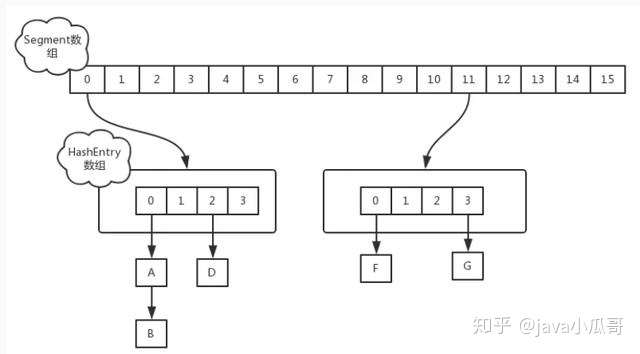
JDK 1.7 中,采用分段锁的机制,实现并发的更新操作,底层采用数组+链表的存储结构,包括两个核心静态内部类 Segment 和 HashEntry。
-
Segment 继承 ReentrantLock(重入锁) 用来充当锁的角色,每个 Segment 对象守护每个散列映射表的若干个桶;
-
HashEntry 用来封装映射表的键-值对;
-
每个桶是由若干个 HashEntry 对象链接起来的链表