NOTE
6.8 策略模式
1. 定义 完成同一件事有多种不同的方式,根据不同的type选择不同的算法,用if else太恶心 与状态模式的区别在于策略模式每种策略都是为了完成同一件事,而状态模式则是为了完成不同的事 2. uml 3. Java 3.1. client 3.2. context 3.3. 策略 4. Gola
这是历史学习笔记,可能存在过时或不完整的理解。
1. 定义
完成同一件事有多种不同的方式,根据不同的type选择不同的算法,用if else太恶心
与状态模式的区别在于策略模式每种策略都是为了完成同一件事,而状态模式则是为了完成不同的事
2. uml
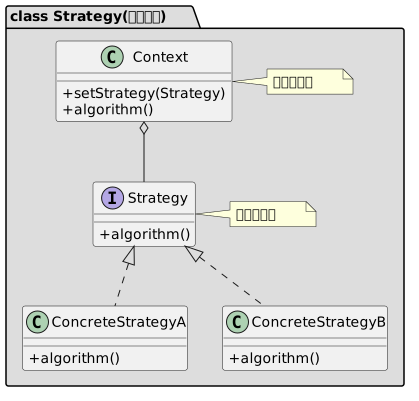
3. Java
3.1. client
public class Client
{
    public static void main(String[] args)
    {
        double price = 100.0;

        StrategyContext context = new StrategyContext();

        //老客户少量
        context.setStrategy(new OldCustomerFew());
        context.getPrice(price);

        //新客户少量
        context.setStrategy(new NewCustomerFewer());
        context.getPrice(price);
    }
}
3.2. context
public class StrategyContext
{
    private Strategy strategy;

    public Strategy getStrategy()
    {
        return strategy;
    }

    public void setStrategy(Strategy strategy)
    {
        this.strategy = strategy;
    }

    public void getPrice(double price)
    {
        System.out.println(this.strategy.getPrice(price));
    }
}
3.3. 策略
public interface Strategy
{
    double getPrice(double price);
}
public class NewCustomerFewer implements Strategy
{
@Override
public double getPrice(double price)
{
return price * 0.95;
}
}public class NewCustomerMany implements Strategy
{
@Override
public double getPrice(double price)
{
return 0.9 * price;
}
}public class OldCustomerFew implements Strategy
{
@Override
public double getPrice(double price)
{
return price * 0.85;
}
}4. Golang
4.1. 策略
/*用户打折策略*/
type IStrategy interface {
	GetPrice(price float64) float64
}

//老用户打折多的策略
type OldCustomerMuchStrategy struct {
}

func NewOldCustomerMuch() *OldCustomerMuchStrategy {
	return &OldCustomerMuchStrategy{}
}

func (o OldCustomerMuchStrategy) GetPrice(price float64) float64 {
	return price * 0.5
}

//新用户打折少的策略
type NewCustomerMuchStrategy struct {
}

func NewNewCustomerFew() *NewCustomerMuchStrategy {
	return &NewCustomerMuchStrategy{}
}

func (o NewCustomerMuchStrategy) GetPrice(price float64) float64 {
	return price * 0.8
}
4.2. 策略管理器
/*策略管理器*/
type StrategyContext struct {
	strategy IStrategy
}

func NewStrategyContext() *StrategyContext {
	return &StrategyContext{}
}

func (s *StrategyContext) Strategy() IStrategy {
	return s.strategy
}

func (s *StrategyContext) SetStrategy(strategy IStrategy) {
	s.strategy = strategy
}

//打折
func (s *StrategyContext) GetPrice(price float64)  {
	fmt.Printf("折扣后的价格:%f\n", s.strategy.GetPrice(price))
}
4.3. client
func main() {
	price := 100.0
	strategyContext := 策略模式.NewStrategyContext()
	strategyContext.SetStrategy(策略模式.NewOldCustomerMuch())
	strategyContext.GetPrice(price)
	strategyContext.SetStrategy(策略模式.NewNewCustomerFew())
	strategyContext.GetPrice(price)
}
5. 实例
模板方法+简单工厂+策略模式
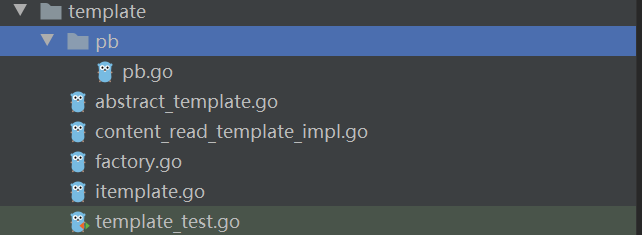
- pb.go
package pb

type SwitchRoomReq struct {

}

type SwitchRoomRsp struct {

}- abstract_template.go
package template

import (
	"context"
	"fmt"
	"test/template/pb"
)

/*实现了IFetchDataService*/
type abstractFetchDataService struct {
	IFetchDataSteps //内部的处理步骤
	req             *pb.SwitchRoomReq
	rsp             *pb.SwitchRoomRsp
	basicInfo       interface{} //基础数据
	extraInfo       interface{} //额外数据
}

func (t *abstractFetchDataService) checkParam(ctx context.Context) error {
	fmt.Println("default checkParam")
	return nil
}

func (t *abstractFetchDataService) getBasicInfo(ctx context.Context) error {
	fmt.Println("default getBasicInfo")
	return nil

}

func (t *abstractFetchDataService) getExtraInfo(ctx context.Context) error {
	fmt.Println("default getExtraInfo")
	return nil

}

//newTemplate
func newTemplate(iSteps IFetchDataSteps) *abstractFetchDataService {
	return &abstractFetchDataService{IFetchDataSteps: iSteps}
}

/*模板方法固定的步骤*/
func (t *abstractFetchDataService) HandleRequest(ctx context.Context, req *pb.SwitchRoomReq, rsp *pb.SwitchRoomRsp) error {
	t.req = req
	t.rsp = rsp
	if err := t.IFetchDataSteps.checkParam(ctx); err != nil {
		return err
	}
	if err := t.IFetchDataSteps.getBasicInfo(ctx); err != nil {
		return err
	}
	if err := t.IFetchDataSteps.getExtraInfo(ctx); err != nil {
		return err
	}
	return nil
}- content_read_template_impl.go
package template

import (
	"context"
	"fmt"
)

const TypeContentReadService = 2

var contentReadServiceConstructorFunc fetchDataServiceConstructor = func() IFetchDataService {
	return NewFetchDataFromContentReadService()
}

func init() {
	GlobalServiceFactory.RegisterService(TypeContentReadService, contentReadServiceConstructorFunc)
}

/*content_read服务*/
type FetchDataFromContentReadService struct {
	*abstractFetchDataService
}

func (f *FetchDataFromContentReadService) checkParam(ctx context.Context) error {
	fmt.Println("checkParam")
	return f.abstractFetchDataService.checkParam(ctx)
}

func (f *FetchDataFromContentReadService) getBasicInfo(ctx context.Context) error {
	fmt.Println("getBasicInfo")
	return f.abstractFetchDataService.getBasicInfo(ctx)

}

//func (f *FetchDataFromContentReadService) getExtraInfo(ctx context.Context) error {
//	fmt.Println("getExtraInfo")
//	return f.abstractFetchDataService.getExtraInfo(ctx)
//
//}


//NewFetchDataFromContentReadService
func NewFetchDataFromContentReadService() *FetchDataFromContentReadService {
	service := &FetchDataFromContentReadService{}
	service.abstractFetchDataService = newTemplate(service)
	return service
}- factory.go
package template

import "fmt"

var GlobalServiceFactory = newServiceFactory()

//自定义func。用于创建service实例
type fetchDataServiceConstructor = func() IFetchDataService

//serviceFunc工厂
type serviceFactory struct {
	serviceMap map[int]fetchDataServiceConstructor
}

//newServiceFactory
func newServiceFactory() *serviceFactory {
	return &serviceFactory{serviceMap: make(map[int]fetchDataServiceConstructor)}
}

//根据service type获取service
func (s *serviceFactory) GetServiceByType(serviceType int) (IFetchDataService, error) {
	serviceConstructor, ok := s.serviceMap[serviceType]
	if ok {
		return serviceConstructor(), nil
	}
	err := fmt.Errorf("GetServiceByType: serviceType %v invalid", serviceType)
	return nil, err
}

//注册serviceType和serviceConstructor
func (s *serviceFactory) RegisterService(serviceType int, serviceConstructor fetchDataServiceConstructor) {
	s.serviceMap[serviceType] = serviceConstructor
}- itemplate.go
package template

import (
	"context"
	"test/template/pb"
)

/*对外提供获取数据列表的接口*/
type IFetchDataService interface {
	HandleRequest(ctx context.Context, req *pb.SwitchRoomReq, rsp *pb.SwitchRoomRsp) error
}

/*内部的处理步骤*/
type IFetchDataSteps interface {
	//检查参数
	checkParam(ctx context.Context) error
	//获取基础数据
	getBasicInfo(ctx context.Context) error
	//获取额外数据
	getExtraInfo(ctx context.Context) error
}- template_test.go
package template

import (
	"context"
	"testing"
)

func TestTemplate(t *testing.T) {
	service, _ := GlobalServiceFactory.GetServiceByType(TypeContentReadService)
	service.HandleRequest(context.Background(), nil, nil)
}
//输出
checkParam
default checkParam
getBasicInfo
default getBasicInfo
default getExtraInfo