
NOTE
1.1 Time-Series Database
Time-series databases, time-series data, data models, and storage implementation.
This is a historical learning note and may contain outdated or incomplete understanding.
1. What Is a Time-Series Database
A time-series database is a database optimized for timestamped or time-series data.
Time-series databases are optimized for continuous timestamped writes, compression, aggregation, and time-range queries. Relational databases can also store historical data; the difference is mainly the data model and the optimizations made for time-series workloads.
2. What Is Time-Series Data
Time-series data is a sequence of observations associated with time.
3. Why Use a Time-Series Database
3.1. Recording with a Relational Model
- If time-series data is stored in an ordinary table:
- Common challenges at large scale include:
- high write volume;
- expensive time-based aggregation;
- storage cost.
3.2. Time-Series Model
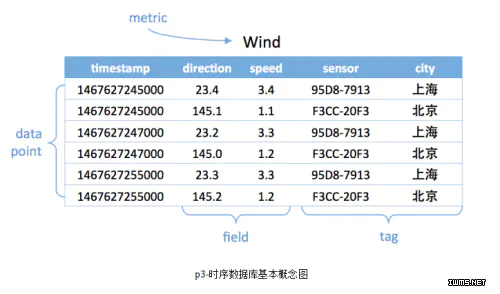
The exact terminology varies by product. In an InfluxDB-style model:
- metric: the metric name. It can be loosely compared with a table in a relational database.
- data point: one observation, loosely comparable with a row.
- timestamp: when the data point was produced.
- field: a value that commonly changes over time, such as wind direction or speed.
- tag: indexed metadata that commonly identifies a series, such as sensor or city.
In the example:
- the metric is
Wind, and every data point has a timestamp; - fields are
directionandspeed; - tags are
sensorandcity.
4. Time-Series Database Implementation
4.1. LSM Tree
LSM trees are commonly used in write-heavy storage systems.
4.2. Distributed Storage
When time-series volume exceeds the capacity or throughput of one machine, data can be distributed across multiple nodes. Small deployments do not inherently require distributed storage.
4.2.1. Distribution Algorithm
A distributed TSDB needs a partitioning strategy that determines where series are stored.
4.2.2. Shard Key
A common idea is to partition by a combination such as metric + tags so that points from the same logical series can remain colocated for time-range access. Actual designs vary by database.