
NOTE
3.1 Go's G-M-P Scheduler
The Go scheduler's G, M, and P abstractions, local run queues, work stealing, blocking syscalls, GOMAXPROCS, and asynchronous preemption.
This is a historical learning note and may contain outdated or incomplete understanding.
1. Why Go Needs a Scheduler
A Go program may have far more runnable goroutines than operating-system threads. The runtime scheduler decides which goroutine runs on which thread and when.
Earlier Go schedulers relied more heavily on a global runnable queue. The modern design adds per-processor local queues and work stealing to reduce contention and improve locality.
2. G, M, and P
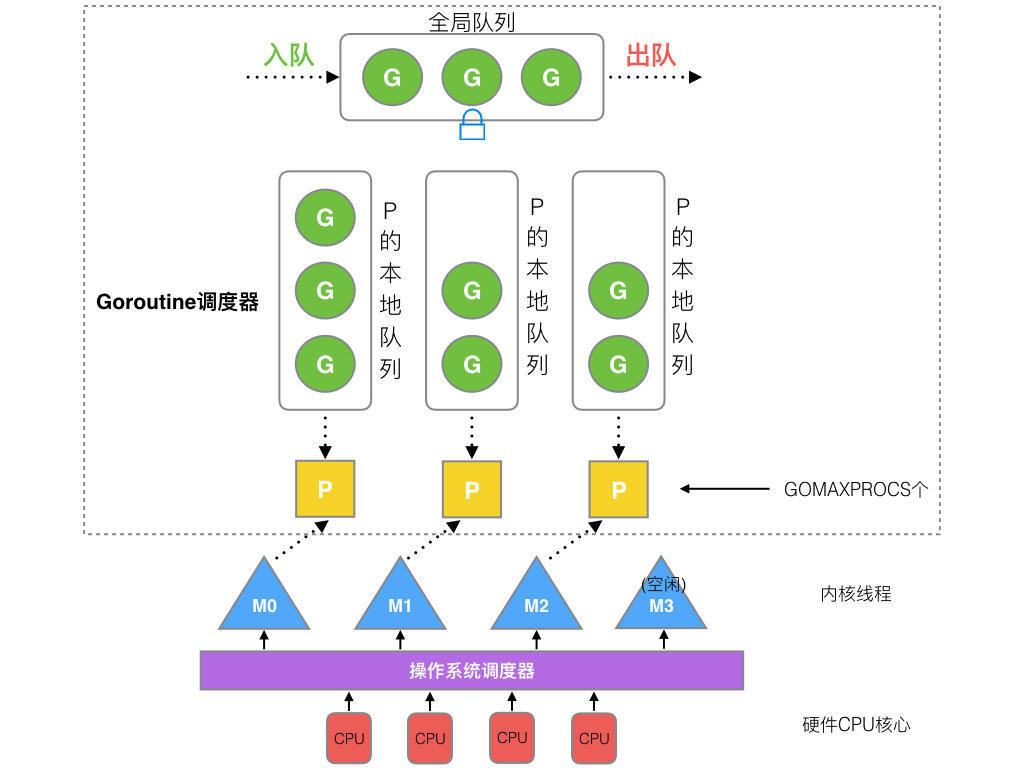
2.1 G — Goroutine
G represents a goroutine: its stack, scheduling state, and execution metadata.
2.2 M — Machine
M represents an operating-system thread used by the runtime.
The runtime creates and parks OS threads as needed. runtime/debug.SetMaxThreads defines a safety limit; its default value must not be interpreted as “Go creates 10,000 threads by default.”
2.3 P — Processor
P represents the resources required to execute Go code. A runnable goroutine executes when an M owns a P.
GOMAXPROCS controls how many Ps can execute Go code simultaneously.
3. Run Queues and Work Stealing
Each P maintains a local runnable queue. This avoids making every scheduling operation contend on one global queue.
When a P has no local work, the scheduler can search other sources, including:
- the global runnable queue;
- network-poller results;
- another P’s run queue through work stealing.
This design balances locality with utilization.
4. Blocking Operations
If an M blocks in a syscall, the runtime can detach its P and let another M continue running Go code on that P. Network I/O integrated with the runtime poller can park the goroutine rather than consuming one thread per blocked socket.
5. g0 and Runtime Work
Each M has a special scheduler goroutine often referred to as g0. Runtime operations such as scheduling and stack-management work execute on runtime-managed stacks rather than as ordinary user goroutines.
6. Preemption
Go originally depended more heavily on cooperative safe points. Modern Go also supports asynchronous preemption (introduced in Go 1.14), which helps prevent long-running goroutines from monopolizing a P even when they do not frequently call into the runtime.
Exact scheduler internals are version-sensitive. The durable model is: G is work, M is an OS thread, P is the right to/resources needed to execute Go code, and the runtime continuously moves runnable Gs onto available P/M pairs.